
Batch-Automatic Centrifuges Horizontal Peeler & Vertical Bottom-Discharge Platforms for High-Throughput Batch Separation
Rousselet Robatel designs and manufactures automatic-discharge centrifuges — horizontal peeler centrifuges with scraper/knife discharge and vertical bottom-discharge centrifuges — for batch processes where high throughput, mono/limited-product runs, and minimal operator handling of the product matter more than multi-product flexibility.
- Manual discharge (dig-out, bag, cage-hoist, etc.) keeps capital cost low for frequent product changeover, but it caps throughput and puts an operator in contact with the product every cycle. When a process runs the same (or a few) products at volume, automating the discharge step – scraper, peeler knife, or bottom-discharge chute – removes that bottleneck and enables full PLC cycle control, closed/inerted operation, and C1D1/cGMP builds.
- G-forces to ~1,978 G (EHBL), useful loads to 1,500 kg per cycle (EHBF), up to 2,600 rpm (EHBL503).
- Over 100 years of horizontal- and vertical-axis centrifuge design, in-house fabrication, FAT, global service network.
Horizontal Peeler Centrifuges
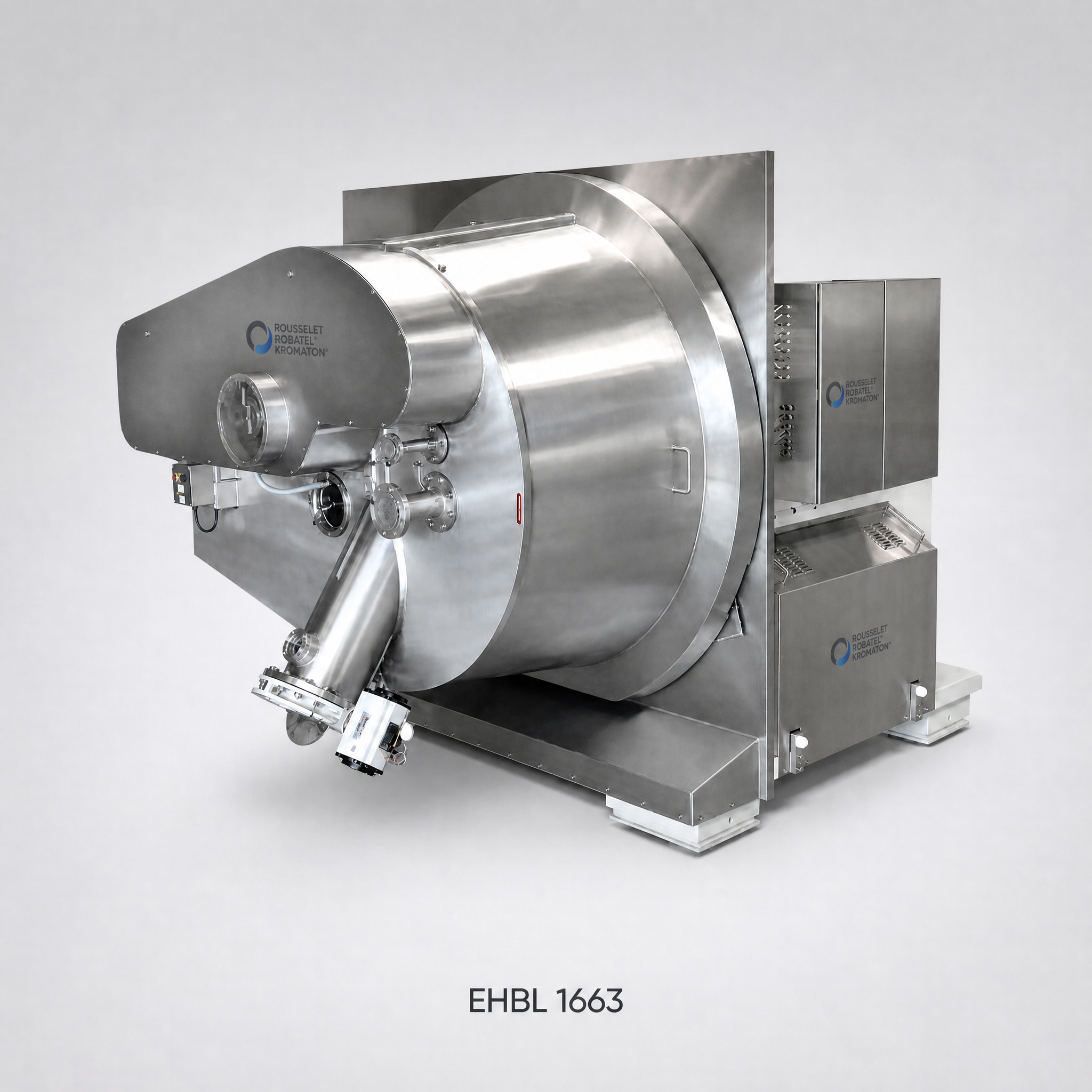
EHBL — Horizontal Axis Peeler Centrifuges (semi-automatic to full automation) with full opening casings
- Full-opening casing (one or two rotations) for instant visual inspection and cleaning
- Ground-level installation, reduced height requirements; option for cleanroom “through-the-wall” installation (process/technical zone separation)
- Scraper discharges into an inclined chute or optional horizontal extraction screw (DRV variant)
- Suspension feed across full basket depth for uniform cake thickness; “soaking” option (low-speed rotation with partial casing fill for cleaning)
- Low residual moisture from high centrifugal force (up to 2,600 rpm on the smallest size, EHBL503)
- Control range: manual through full automation, operator terminal, supervisor communication
- Sizes: EHBL503 (500mm) up to EHBL1663 (1,660mm); useful volumes 24 L–890 L; useful load 30 kg–1,110 kg
- Best fit: processes needing frequent visual/manual inspection access alongside automated cycles, or cleanroom-separated installations
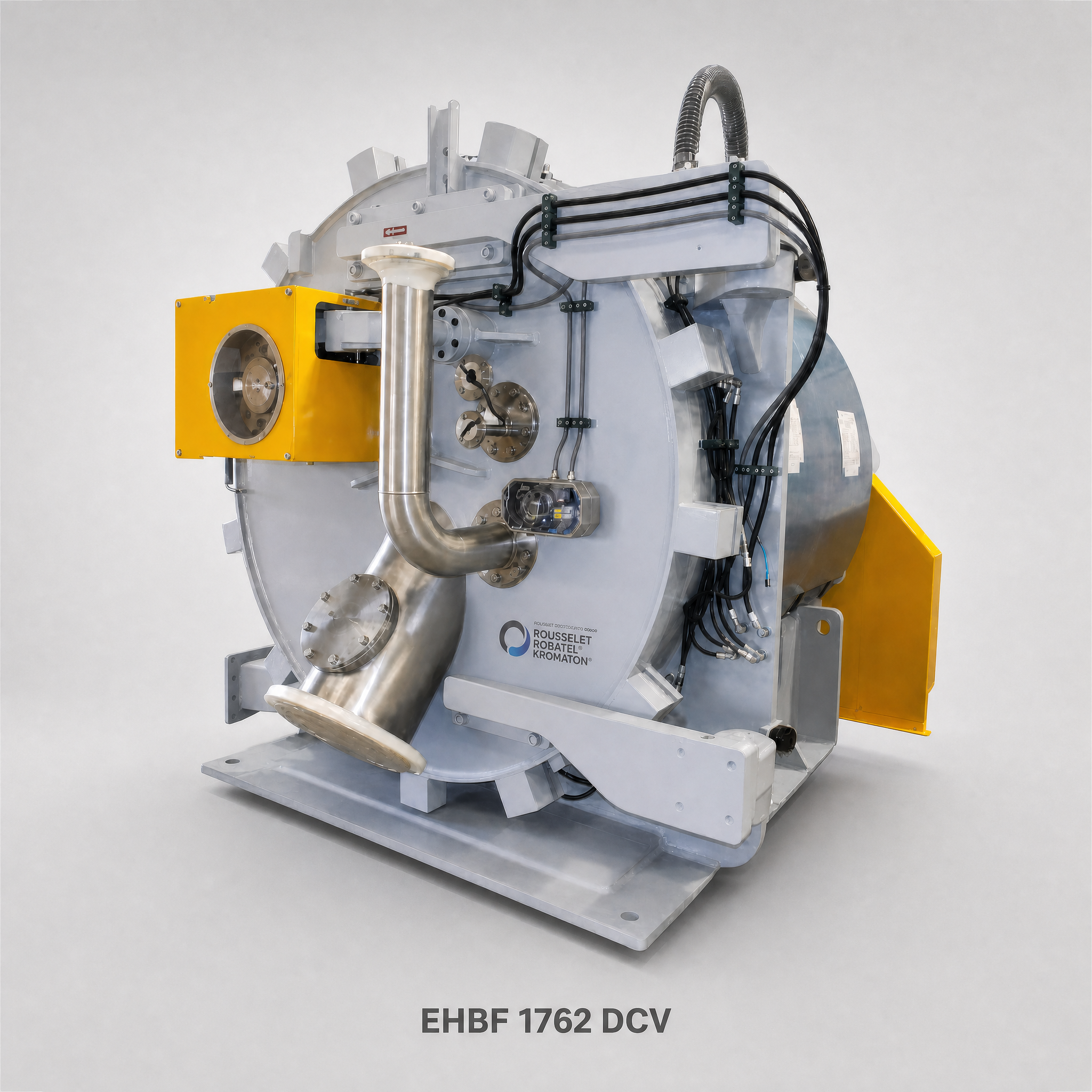
EHBF — Horizontal Axis Peeler Centrifuges (semi-automatic to full automation) with front access door
- Ideal for mono-product applications where cross-contamination is not a concern.
- Front-opening door over the basket to allow for internal maintenance.
- Ground-level installation, reduced height requirements
- Scraper discharges into an inclined chute or optional horizontal extraction screw (DRV variant)
- Suspension feed across full basket depth for uniform cake thickness; “soaking” option (low-speed rotation with partial casing fill for cleaning)
- Low residual moisture from high centrifugal force
- Control range: manual through full automation, operator terminal, supervisor communication
- Best fit: processes manufacturing a single product through the centrifuge, eliminating the concern of cross-contamination. Cost saving non-GMP design where inspection of all surfaces is not required between batches or campaigns.
Vertical Bottom-Discharge Centrifuges
DEC — Industrial Vertical Axis Centrifuge with Bottom Discharge
- Suitable for large-scale production; closed-system operation under controlled atmosphere (operator/product/environment protection)
- Wide diameter/volume range; scraper-knife discharge (single or double motion, axial + radial)
- Confined cake discharge through basket-plate/tank-bottom openings to a chute (simple or extended for downstream connection)
- Two mounting families: RC (inertia slab) and SC (suspension) — same distinction as the batch-manual RC/SC logic: RC keeps site prep simple, SC gives a smaller footprint but needs a reinforced mounting surface
- Semi-automatic or automatic cycle, manual resumption available, supervisor communication option
- Residual-layer removal: internal basket cleaning (rotation + translation), external “blow-back” (nitrogen counter-current), and CIP (rotating + fixed nozzle ramps)
- Sizes: RC63 (630mm) up to RC160 (1,600mm); SC100–SC150; useful volumes 50 L–990 L; up to 1,500 rpm
- Best fit: large-scale, closed/inerted production runs needing full cake-discharge automation without switching to a horizontal platform
- [Brochure download link — C6]
DRC-Vx BO — Vertical Decanter Centrifuge with Automatic Bottom Discharge
- Compact, fully automatic operating principle — no filter media, decanting by density under 1,500–2,200 x G
- Patented sludge-mass detection: feed shuts off automatically at a pre-set sludge mass, then baffle/bowl reversal scrapes solids out through the bowl bottom via a pneumatically actuated anti-drip chute
- Rotating-disc feed matched to bowl speed minimizes turbulence; four-baffle rotor divides the bowl into “calm” zones for faster, more efficient separation
- Aluminum bowl, open bottom, separating deflector; AC variable-frequency drive; independent PLC control enclosure
- Sizes: DRC30 Vx BO (300mm, 15 L) and DRC45 Vx BO (450mm, 48–67 L); throughput to 220 L/min
- Application niche — distinct from the process-scale EHBL/EHBF/DEC lines: industrial sludges/baths (vibratory finishing, rectifying, phosphating, washing, pickling), wash waters, cutting fluids, cooling liquids
- Best fit: compact, continuous-cycle automatic purification of industrial process fluids rather than pharma/fine-chemical batch product recovery
How These Centrifuges Work
Horizontal-axis units (EHBL/EHBF) favor ground-level installation and high-speed scraper/knife discharge into a chute or screw; vertical-axis units (DEC) discharge downward through the basket/bowl bottom, well suited to closed-system/inerted operation.
Feeding → rinsing/washing → spinning (multiple speed/duration steps in one cycle) → scraping/knife discharge or bottom discharge — each step PLC-sequenced, contrasted with the manual dig-out/bag/cage-hoist steps on the batch-manual page.
Internal basket cleaning, external blow-back, and CIP — same three-method framework across EHBL, EHBF, and DEC.
Manual vs. Automatic — Which Do You Need?
Batch-Automatic
- Mono/limited-product
- High-volume runs
- Minimal operator contact with product
Batch-Manual
- Frequent multi-product changeover
- Lower capex
- Time for setup between batches
Horizontal (EHBL/EHBF)
- Ground-level footprint and chute/screw discharge
- High throughput – no need to slow down for discharge
Vertical (DEC)
- Gravity bottom-discharge from mezzanine level
- Handles sticky/difficult solids well
Technical Features That Support Automatic Operation
- C1D1 (Class 1, Division 1, Groups C&D) and other explosion-proof electrical equipment options
- cGMP-ready construction; various construction materials (316L stainless, alloys) and coatings ECTFE, ebonite)
- Gas-tight/inerting capability (pressure control, oxygen analysis, hydraulic siphon/guard)
- PLC control with frequency converter; up to full automation with supervisor communication
- CIP piping with rotating/fixed nozzle ramps; blow-back and internal-basket residual-layer removal
- Safety systems: imbalance/vibration sensors, speed sensors, pressure controls
- Finish/polishing options
Why Choose Rousselet Robatel
Filtration and decantation mechanisms under one platform family, not a single-technology vendor forcing one solution on every process
The same design logic scales from RC20 lab units to RC150/SC200-class production equipment
Materials of construction, C1D1/explosion-proof builds, seal options, CIP systems, and finish grades tailored to application
In-house fabrication, factory acceptance testing
Validate a process on rental equipment or in our wet lab before capital investment
Spare parts, field service, commissioning, preventative maintenance, training
Process Development Support
- Solvent/process evaluation to determine filtration vs. decantation fit for your solids
- Wet lab test center for on-site process evaluation, or rent a pilot unit for testing at your own facility
- Scale-up guidance from RC20/RC30 lab testing through KSA/cage-hoist production equipment
- Application review and feasibility discussions before capital investment
Frequently Asked Questions
A batch-automatic centrifuge allows for continuous processing batches without the need for operator intervention. Batch-manual centrifuges require that operators remove the solids from the basket manually after each batch completes.
Horizontal peelers tend to run cycles faster, as there is no need to slow down the rotational speed to discharge solids. Vertical axis, bottom-discharge centrifuges tend to handle a broader range of products, such as sticky or clumping solids, as the discharge method relies on gravity as opposed to sliding down an inclined chute or via an auger.
Additionally, peeler centrifuges tend to have a larger footprint, while bottom discharge centrifuges have a larger height requirement to accommodate solids collection.
Yes, both horizontal peelers and bottom discharge centrifuges can be equipped with nitrogen blanketing systems and intrinsically safe controls and electronics to meet Class 1, Division 1, Groups C&D standards.
Our standard design uses 316L stainless steel, and we are able to offer a wide range of alternate materials in process contact areas to accommodate several processing needs. A few of the options that we offer are:
- 904L stainless steel for better resistance to sulfuric acid, phosphoric acid, and several other harsh chemicals
- Alloy C22 for heighted resistance to hydrochloric acid
- Inconel for high temperature processes
- Monel 400 for extreme acidic process fluids, such as hydrofluoric acid
- Duplex 2205 or 2507 for abrasion resistance and mechanical strength
Several other materials of construction are possible for fabrication, depending on your process needs.
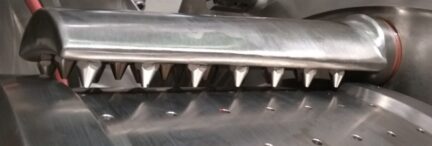
Integrated heel removal devices are available for both out horizontal axis and vertical axis batch-automatic centrifuges. An array of air or nitrogen lances blow through the basket perforations and disrupt the residual cake, directing it towards the discharge mechanism.
Yes, both horizontal peelers and bottom discharge centrifuges can be equipped to operate in cleanroom environments. Horizontal peelers can have an integrated plate to be used in through-the-wall installations, isolating the mechanical parts (belts, grease fittings, etc.) from the cleanroom side of the machine. The lower mechanical section of bottom discharge centrifuges can be equipped with flexible shrouds to isolate the mechanical parts from the cleanroom environment.
Request a Technical Discussion or Application Review
We’ll help you:
- Discuss your solids characteristics and required separation mechanism (filtration vs. decantation)
- Review batch size, changeover frequency, and throughput requirements
- Identify the right platform and scale for your process
- Provide a datasheet, rental unit, or wet-lab evaluation
Let’s get clarity on what we need to build.
Separation, filtration, and extraction processes require different approaches depending on material behavior.