
Batch-Manual Centrifuges for Solid-Liquid Separation
Rousselet Robatel designs and manufactures vertical-axis, batch-manual centrifuges for solid-liquid separation — basket filtration centrifuges and manual/hoisted-cage decanters — from laboratory scale through pilot and full production.
Solid-liquid separation isn’t one problem with one solution. Some products need to be filtered through a media (a cloth or bag) to wash and dewater a cake; others separate best by pure density difference in a solid bowl, with no filter media at all. Getting that choice wrong means fighting your process instead of your equipment. Rousselet Robatel’s vertical-axis batch centrifuges cover both mechanisms under one engineering team — from RC20/RC30 lab units for method development to RC-KSA/SC-KSA high-capacity filtration systems and cage-hoist decanters for production-scale decantation.
Basket Filtration Centrifuges
RA20 / RC20 / RC30 — Laboratory & Kilolab
Compact vertical-axis centrifuges built for R&D and small-scale production, with manual or semi-automatic cycle control.
- Unloading of solids via removable filter bag, or liquids via decanter with skimmer
- Equipment installs on a table or trolley for lab flexibility
- Suitable for both laboratory testing and small-scale production (Kilolab)
- Can be rated for severe conditions: corrosive products, explosive atmospheres (Class 1, Groups C&D, Division 1)
- All product-contact parts in AISI 316L stainless steel or Alloy C22; outer casing in AISI 316L
- Basket: Ø200mm (RA20/RC20) or Ø300mm (RC30), with removable filtration bag
- Cover with EPDM or FEP seal and safety locking device, feed pipe, and sight glass
Best fit: R&D method development and small-batch production where you need to test a filtration process before committing to pilot or production scale.
RC / SC / SA — Pilot to Production
A wide platform family covering two distinct mounting approaches, scaling from pilot to full production throughput.
- RC (inertia plate design): achieves stability through the casing and frame structure on smaller sizes, and through an integrated inertia plate on larger sizes — a self-contained design that keeps site preparation straightforward, with no special foundation engineering required
- SC (three-point suspension): driven by a side-mounted motor connected to a static frequency converter for starting, braking, and speed variation; available in explosion-proof versions — because the centrifuge itself is suspended rather than self-supporting, more site design is required than with an RC installation
- SA (inertia plate design, direct axial motor): electric braking — economical option for aqueous solutions only; cannot be built explosion-proof
- Options: quick-release basket, decanter-conversion kit (available for RC40 and RC50), retractable tank
Best fit: RC when you want a simpler installation with minimal site/foundation work; SC when you need explosion-proof capability with a smaller footprint and can accommodate the additional civil engineering a suspension mount requires; SA when your process is aqueous-only and cost is the priority.
RC-KSA / SC-KSA — Removable Filter Bag, High-Capacity
Purpose-built for multi-product operations that need complete cake discharge with no residual layer. The removable-rim (KSA) configuration is available starting at RC40/SC-equivalent basket sizes and larger — it is not offered on the RC20/RC30 lab-scale units.
- Full-opening lid (flat or domed; manual, pneumatic, or hydraulic lifting depending on size)
- Perforated basket with a removable ring supporting the filter bag — allowing the filter media, once full of product, to be hoisted directly out of the centrifuge
- Semi-automatic “lifting-beam/bag” assembly — operator-controlled opening and repositioning of the bag, reducing handling time and protecting both product and operator from direct contact
- Bag discharge via optional jib crane with automatic hoist
- Same mounting distinction applies here as above: RC-KSA benefits from the floor-mounted, inertia-plate design; SC-KSA carries the same reinforced-mounting-surface consideration as standard SC
- Widest size range on this page: RC40 KSA (400mm) up to RC150 KSA (1500mm); SC range extends to SC200 KSA (2000mm)
- Complete discharge of the spun cake — no residual layer — and easy access inside the basket for cleaning and filter-cloth changeover
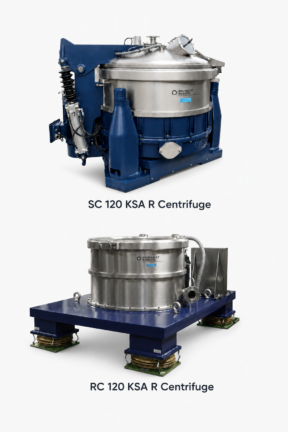
Best fit: high-throughput, multi-product facilities (RC40-size and up) needing fast changeover and complete, contamination-protected cake discharge.
Decanting Centrifuges (Manual Discharge)
Solid-bowl separation by density/settling — no filter medium. Covers manual-discharge configurations only; automated-discharge (skimmer or scraper/bottom-discharge) decanter configurations of these same platforms are covered on our batch-automatic centrifuges page, and continuous dual-skimmer decanters are covered in the continuous section of that page.
Small-Format Manual Dig-Out (DRA20 / DRC30 / DRC40-style)
The same compact platforms used for basket filtration, reconfigured with a solid bowl for decantation instead of a filter medium.
- Solid bowl replaces the filter basket — separation by centrifugal settling only
- Too small in scale to justify an automated discharge mechanism; solids are removed by operator dig-out after each run
- Available with baffles to ensure even product distribution and reduced vibration
- Bowl options: with holes (filled by plugs) in the upper rim to define different useful volumes, or in the bottom plate for gravity-draining remaining liquid once stopped
Best fit: R&D and small-batch decantation work — testing whether decantation (rather than filtration) is the right separation mechanism for your product before scaling up.
Removable Cage-Skeleton Decanters (DRC-K / DSC-K / DSC-KP)
For larger decantation runs where dig-out alone isn’t practical, a removable paddled cage speeds up and completes solids removal.
- Rimless bowl receives a removable cage designed with paddles for easier, faster, and more complete removal of dense cake/sediment
- KP variant: cage wrapped with a textile bag, preventing sediment loss in case of cake collapse during handling
- Cage is hoisted out (via crane/hoist) and manually cleaned — faster and more thorough than dig-out alone, without requiring a fully automated discharge system
- Size range: DRC50K up to DSC100K and larger, with useful volumes from 40L up to 250L+ and sediment capacities from 18L up to 100L+
- Materials: cast iron, carbon steel, various stainless steel grades, alloys, titanium, with corrosion-protective coatings (e.g., HALAR) and application-specific (food/pharmaceutical) polishing on wetted parts
Best fit: production-scale decantation where manual handling is still preferred (multi-product flexibility, lower capital cost) but full dig-out would be too slow or incomplete.
How These Centrifuges Work
Filtration vs. Decantation
Basket filtration centrifuges separate solids from liquid by passing the liquid through a filter medium (cloth or bag) under centrifugal force, building a cake of solids on the medium that can be washed and dewatered in place. Decanting centrifuges use a solid bowl with no filter medium at all — separation happens purely by density difference under centrifugal force, with the heavier (solid) phase moving to the bowl wall and the lighter (liquid) phase drained off, typically by overflow or a skimmer pipe. Choosing between them comes down to whether your solids need in-place washing/dewatering through a media (filtration) or simply need to be separated from the liquid phase by density (decantation).
Manual Discharge — Dig-Out, Bag, and Cage-Hoist
“Manual” discharge covers a spectrum, not a single method:
- Dig-out: operator manually removes settled solids after the bowl stops — simplest, lowest-cost, best suited to small volumes (RC20/RC30, small DRA/DRC decanters)
- Removable filter bag: the cake stays contained in a bag that lifts out as a unit — faster than dig-out, supports easy multi-product changeover (KSA range)
- Hoisted removable cage: a paddled cage captures dense sediment and is lifted out by crane/hoist for cleaning — faster and more complete than dig-out for larger decantation volumes (DRC-K / DSC-K)
All three keep capital cost lower than a fully automated discharge system while still giving you real flexibility across multiple products — the tradeoff is operator involvement in every cycle, which is exactly the right tradeoff for lower-throughput or highly variable multi-product operations.
Choosing the Right Batch-Manual Platform
Filtration (RC20/30, RC/SC/SA, RC-KSA/SC-KSA) if you need in-place cake washing, higher level of dryness, or the material does not blind filters; decantation (DRA/DRC dig-out, DRC-Vx K/DSC-K) if density separation alone is sufficient, if the particles are too small for filtration, or if the solid characteristics blind filters.
Lab/R&D: RC20/RC30 or small dig-out decanters. Pilot-to-production: RC/SC/SA range. High-capacity/production: RC-KSA/SC-KSA or DSC-K/DSC-KP.
Frequent multi-product changeover favors removable filter bag (KSA) or hoisted cage (K/KP) designs over basic dig-out — faster cleanout, less cross-contamination risk.
SC and RC lines support explosion-proof construction; RA and SA (direct axial motor) models cannot be built explosion-proof and are limited to non-flammable solutions.
RC (inertia plate + vibration isolators, resting on the floor) needs minimal site preparation but a larger equipment footprint. SC (three-point suspension) has a smaller footprint and supports explosion-proof configurations, but requires a suitable reinforced mounting surface since there’s no inertia plate to absorb vibration.
Talk to a specialist about your solids characteristics, batch size, and changeover frequency.
Technical Features That Support Separation Performance
- All product-contact parts available in AISI 316L stainless steel, Alloy C22, and other grades/alloys on request
- Corrosion-protective coatings available (e.g., HALAR/ECTFE) for wetted parts
- Explosion-proof electrical equipment (EU and North American standards)
- cGMP-ready construction for multi-product pharmaceutical processing
- Seal/gasket options: EPDM, PTFE, PTFE-coated Viton, PTFE-coated silicone, Neoprene
- Gas-tight construction available for nitrogen inerting (pressure control, hydraulic guard inerting systems)
- Safety systems: imbalance/vibration sensors, full compliance with current centrifuge safety standards
- Optional CIP (clean-in-place) piping with rotating head, for both basket and decanter lines
- Finish options: various grades of mechanical polishing per application (food/pharmaceutical-specific finishes available)
Why Choose Rousselet Robatel
Filtration and decantation mechanisms under one platform family, not a single-technology vendor forcing one solution on every process
The same design logic scales from RC20 lab units to RC150/SC200-class production equipment
Materials of construction, ATEX/explosion-proof builds, seal options, CIP systems, and finish grades tailored to application
In-house fabrication, factory acceptance testing
Validate a process on rental equipment or in our wet lab before capital investment
Spare parts, field service, commissioning, preventative maintenance, training
Process Development Support
- Solvent/process evaluation to determine filtration vs. decantation fit for your solids
- Wet lab test center for on-site process evaluation, or rent a pilot unit for testing at your own facility
- Scale-up guidance from RC20/RC30 lab testing through KSA/cage-hoist production equipment
- Application review and feasibility discussions before capital investment
Frequently Asked Questions
Filtration centrifuges separate solids using a filter medium (cloth or bag), allowing the cake to be washed and dewatered in place. Decanting centrifuges use a solid bowl with no filter medium — separation happens purely by density difference under centrifugal force.
Manual discharge (dig-out, removable filter bag, or hoisted cage) keeps capital cost lower and offers strong flexibility for multi-product operations with frequent changeover. Automated discharge is better suited to high-volume, single- or limited-product runs where operator involvement in every cycle would be a bottleneck.
Yes — the RC and SC lines support Class 1, Division 1, Groups C&D compliance and explosion-proof electrical equipment. The SA line (direct axial motor) cannot be built explosion-proof and is limited to aqueous solutions.
AISI 316L stainless steel and Alloy C22 are standard for product-contact parts, with other stainless grades and alloys available on request. Our lines also offer corrosion-protective coatings such as HALAR.
Yes — cGMP-ready construction is available across the platform range for multi-product pharmaceutical processing.
Request a Technical Discussion or Application Review
We’ll help you:
- Discuss your solids characteristics and required separation mechanism (filtration vs. decantation)
- Review batch size, changeover frequency, and throughput requirements
- Identify the right platform and scale for your process
- Provide a datasheet, rental unit, or wet-lab evaluation
Let’s get clarity on what we need to build.
Separation, filtration, and extraction processes require different approaches depending on material behavior.