
Kromaton FCPC® Fast Centrifugal Partition Chromatography Systems
What Is Centrifugal Partition Chromatography?
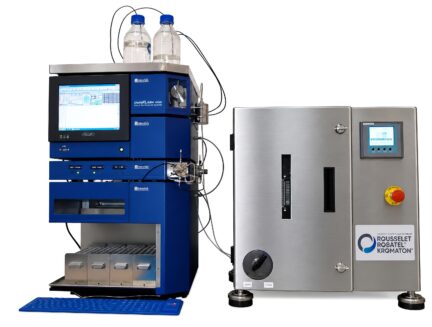
Key points:
- CPC is a liquid-liquid chromatography technique used for extraction, separation, and purification.
- It does not rely on solid packing media — no silica, no resin, no column to pack or regenerate.
- Separation occurs through partitioning between two immiscible liquid phases.
- Molecules separate according to their partition coefficient (Kd).
- CPC is used in preparative workflows from laboratory research through industrial-scale production.

How Fast Centrifugal Partition Chromatography Works
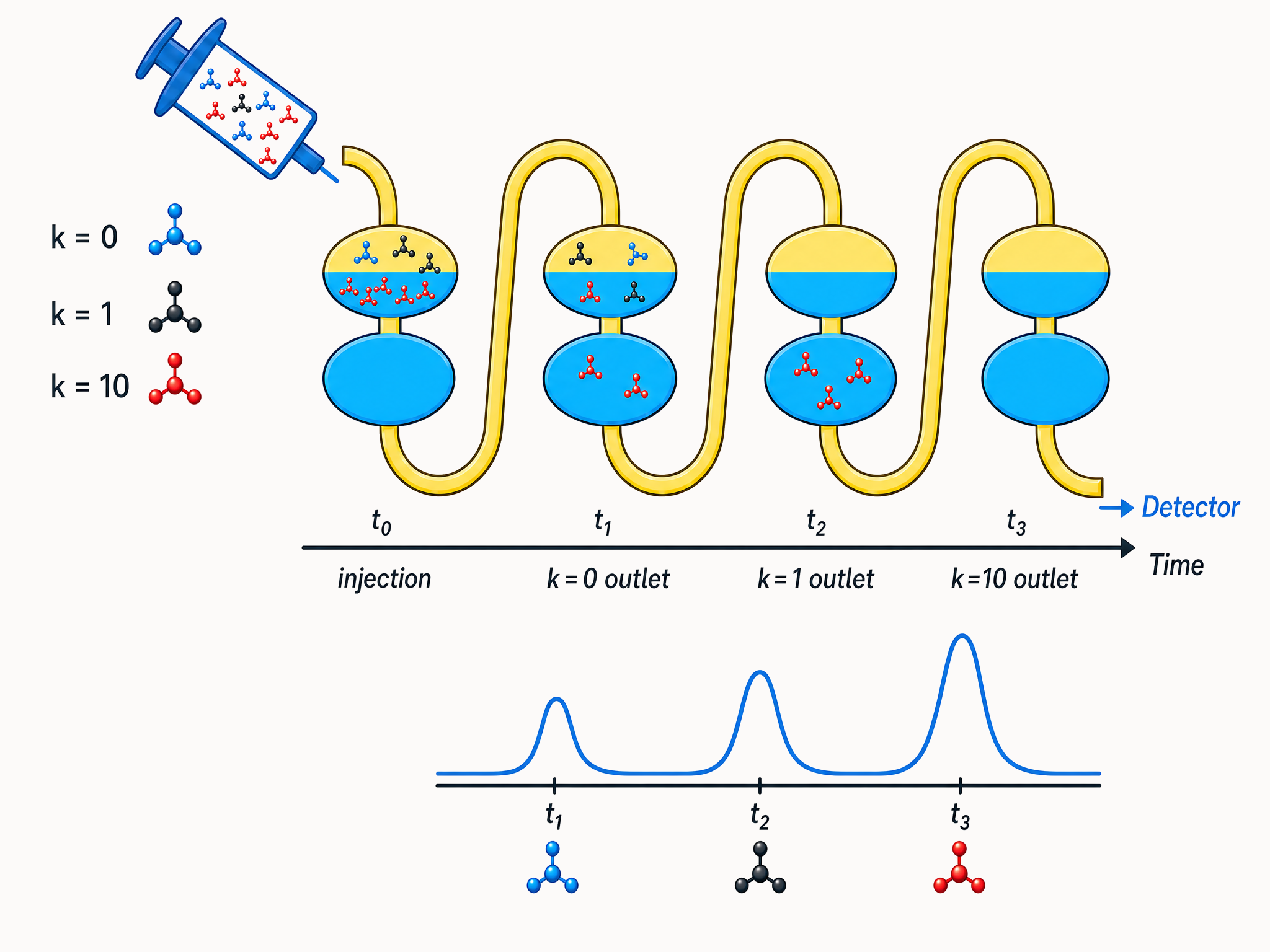
Liquid-Liquid Partitioning and Kd
Two immiscible liquid phases form the separation system. As sample moves through the rotor, dissolved solutes continuously distribute between the two phases according to their partition coefficient (Kd) — the ratio that governs how strongly a compound favors one liquid over the other.
Stationary and Mobile Phase Retention
One liquid phase is retained inside the rotor as the stationary phase under centrifugal force, while the second phase is pumped through as the mobile phase. The stability of this retention — and how much stationary phase volume is preserved during a run — directly affects resolution.
Rotor and Cell Design
The rotor is built from a cascade of interconnected cells (in Kromaton’s design, arranged as twin cells), engineered so the two liquid phases mix and settle repeatedly as they move through the rotor. Each pass through a cell acts as a discrete partitioning stage — with several hundred stages typically available across the rotor, the cumulative separating power scales well beyond a single-stage extraction.
Elution and Extrusion
Once target compounds have partitioned to the desired resolution, elution continues the normal mobile-phase flow to recover separated fractions, while extrusion — pushing the stationary phase itself out of the rotor — can be used to recover strongly retained compounds or to clean out the system between runs.
Why Use Fast Centrifugal Partition Chromatography for Preparative Purification?
FCPC solves problems that solid-phase preparative techniques structurally cannot avoid. Because the entire separation happens between two liquids, there is no packing material to foul, degrade, or dispose of — which changes both the economics and the risk profile of a purification process.
Scalable from Lab to Production Scale
The same liquid-liquid partitioning principle governs an analytical-scale run and an industrial-scale run. Because the physics doesn’t change with scale, methods developed on a small system transfer predictably to pilot and production hardware — shortening scale-up timelines and reducing re-development risk.
High Recovery / Low Sample Loss
Because compounds are never adsorbed onto a solid surface, the risk of irreversible binding — and the yield loss that comes with it — is greatly reduced. This makes FCPC particularly well suited to valuable, low-abundance, or structurally sensitive target molecules where every percentage point of recovery matters.
Low Solvent and Lower Ongoing Consumables
Liquid-liquid separation typically requires less solvent than comparable solid-bed preparative runs, and eliminates the recurring cost of replacement packing. Over the life of a purification program, this shifts the total cost of ownership meaningfully compared with prep HPLC or flash systems.
No Solid Packing Media
With no column to pack, condition, or replace, FCPC removes an entire category of consumable cost and downtime. There’s no stationary media to regenerate between batches and no packing material to dispose of as hazardous waste — a meaningful operating-cost and environmental-compliance advantage at scale.
Note: Performance advantages vary by chemistry and application — solvent system, target molecule polarity, and matrix complexity all affect outcomes. Talk to our applications team about your specific separation.
When to Consider CPC Instead of Preparative HPLC or Flash Chromatography
CPC isn’t a universal replacement for solid-phase preparative techniques — it’s the right tool when a liquid-liquid approach offers a clear process advantage.
Consider CPC when:
- Solid-phase systems present adsorption, degradation, or media-cost issues
- You’re working with complex crude extracts or feed streams that foul columns or clog beds in prep HPLC or flash chromatography
- Your process needs high recovery, gentle handling, or broad polarity flexibility
- You need lab-to-pilot-to-production purification continuity without re-inventing the method at each stage
- You need prefractionation ahead of a downstream purification step
How to choose different chromatography types:
- Your feed is a complex crude extract or difficult matrix that fouls solid media
- Target molecules are fragile or prone to irreversible adsorption
- Low solvent consumption and reduced consumable cost matter at scale
- You need a method that scales from lab to industrial production
- High-resolution separation of well-characterized, clean samples is required
- Analytical-grade purity is the priority over throughput
- You’re working with small sample volumes with well-defined polarity ranges
- Column packing and regeneration infrastructure is already in place
- Rapid, low-resolution separation of relatively simple mixtures is sufficient
- Speed and low cost per run matter more than ultimate purity
- You need early-stage / low-value fractionation before further purification
- Silica-based separation is acceptable for the target compound class
Molecules, Matrices, and Applications Supported
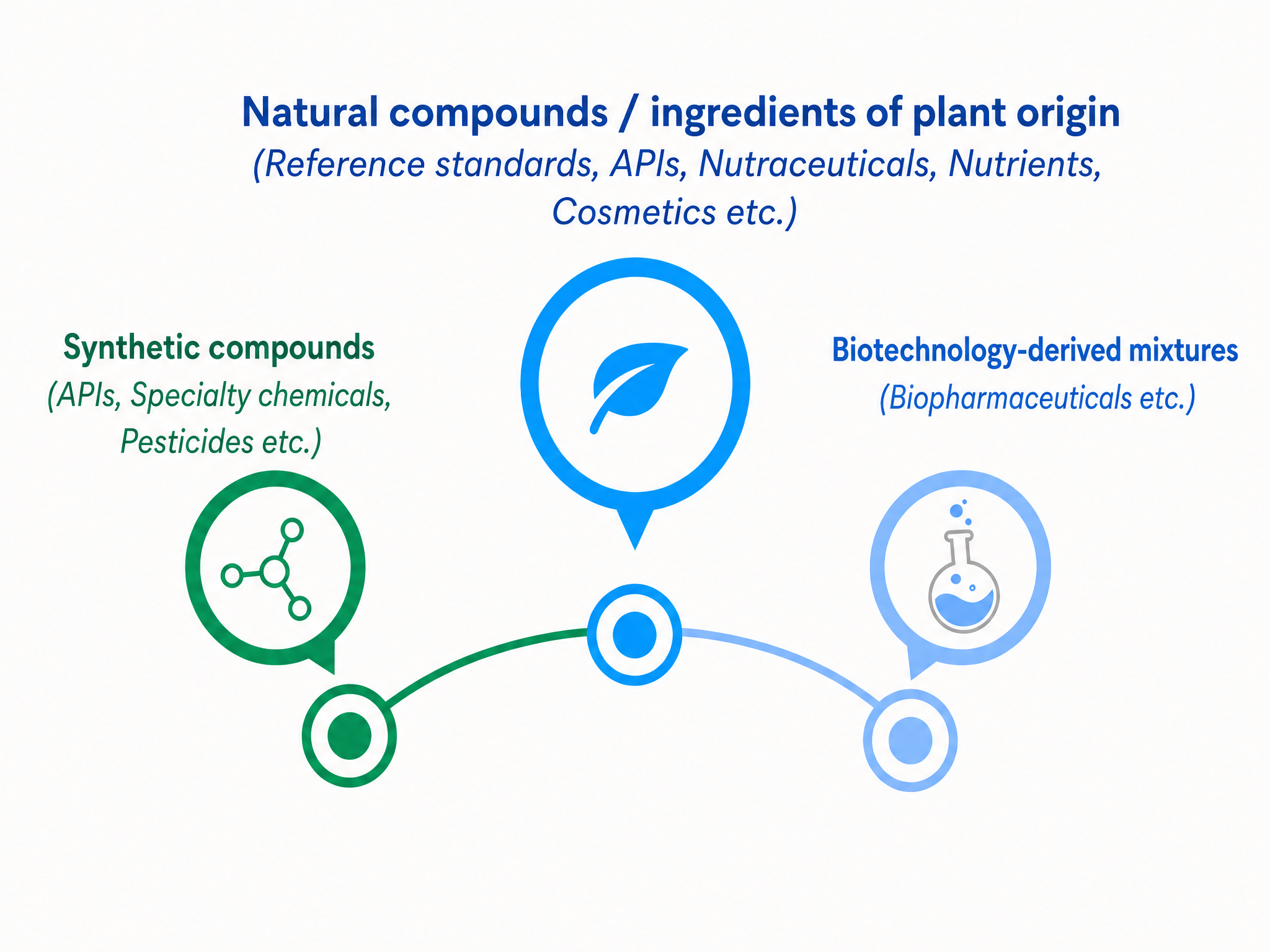
FCPC handles a broad range of feed types because its separation mechanism — liquid-liquid partitioning — doesn’t depend on a fixed solid-phase chemistry. Below are the primary application categories.
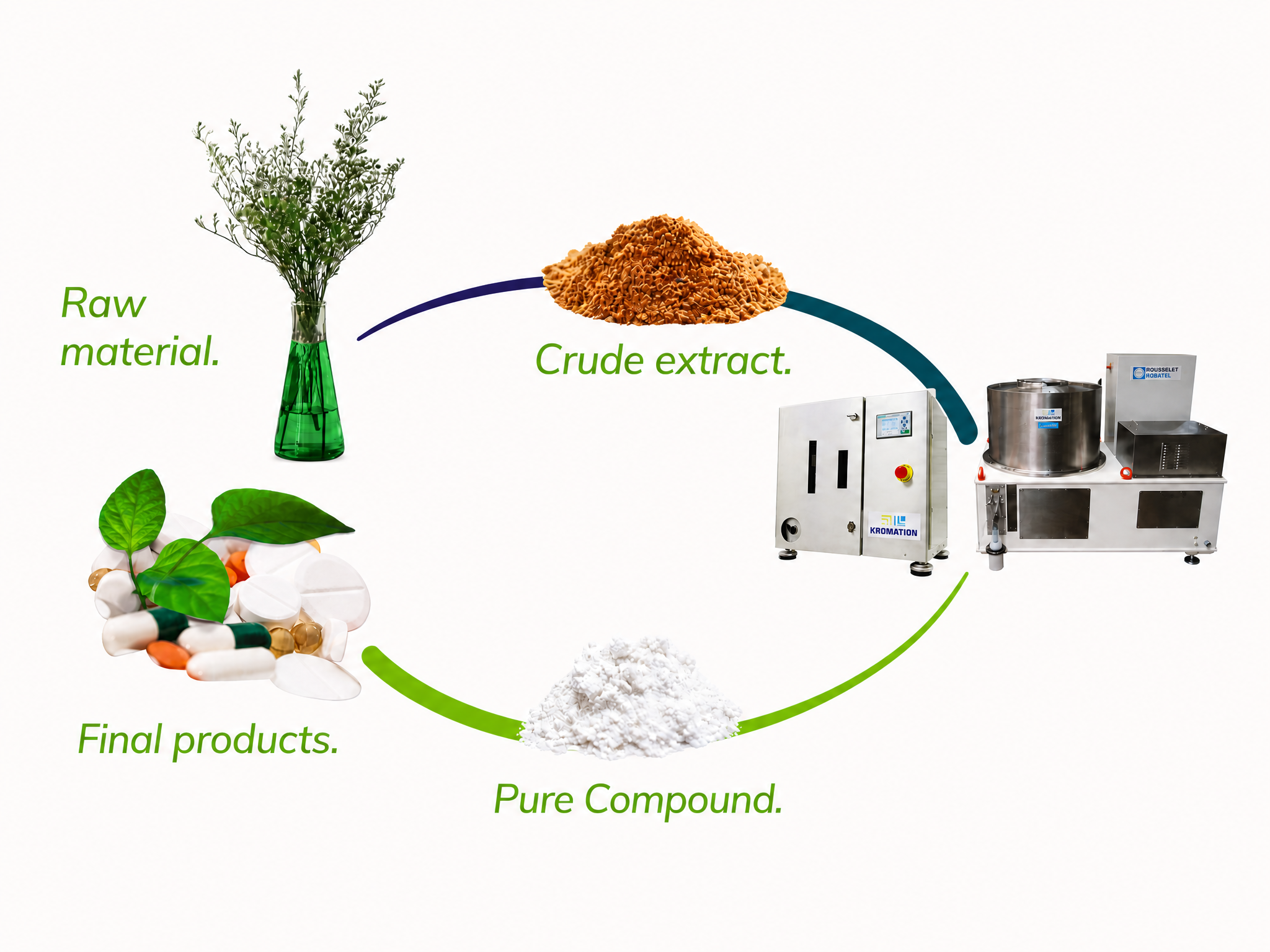
Separation Goal: Isolate and purify target actives from complex plant matrices
Why to use FCPC: Handles broad polarity ranges and complex crude matrices without fouling
Typical Use Case: Prefractionation and final purification
Likely Scale: R&D → Pilot → Production
Separation Goal: Purify peptides, oligonucleotides, and biologically derived compounds
Why to use FCPC: Gentle, non-adsorbing separation preserves sensitive structures
Typical Use Case: Final purification of biological matrices
Likely Scale: R&D → Pilot
Separation Goal: Separate reaction mixtures and synthetic intermediates
Why to use FCPC: Predictable scale-up supports process economics
Typical Use Case: Purification of synthetic mixtures
Likely Scale: Pilot → Production
Separation Goal: Isolate target cannabinoids from crude extract
Why to use FCPC: Purification and fractionation without solid media contamination risk
Typical Use Case: Fractionation and final purification
Likely Scale: Pilot → Production
Separation Goal: Achieve high-purity active ingredient
Why to use FCPC: Purity, process consistency, and validated scale-up
Typical Use Case: Final purification
Likely Scale: Production
CPC Systems From Analytical to Industrial Scale
Kromaton FCPC systems are built as a coherent product family so a method developed at analytical scale carries forward predictably through pilot and into full production.
Analytical-Scale CPC
Designed for method development and feasibility studies. Ideal for R&D teams screening solvent systems and target-compound behavior before committing to larger runs. Kromaton A50/A200: Sample sizes from 10 milligrams to 5 grams.
Flexible Scale-Up Systems
Bridges the gap between R&D and production — used for process development, scale-up validation, and mid-volume preparative runs. Kromaton A1000: Sample sizes from half a gram to 30 grams or more.
Industrial-Scale CPC
Built for continuous production-scale purification, with the rotor architecture and materials of construction to support long-duration, high-throughput operation. Kromaton D5000/D1000: Sample sizes from tens of grams to 1 kilogram.
Kromaton FCPC® Size Comparisons
Used for method development, feasibility studies
10 mg to 500 mg sample injection size
R&D scale
Establishes solvent system and confirms Kd baseline
More information on the Kromaton website or by downloading the Kromaton Brochure
Used for process development, pilot production
10 mg to 30 g sample injection size
Late R&D and Pilot scale
Validates method at intermediate scale
More information on the Kromaton website or by downloading the Kromaton Brochure
Used for large scale batch production and purification
10 g to 1 kg sample injection size
Production
Full-scale deployment of validated method
More information on the Kromaton website or by downloading the Kromaton Brochure
Technical Features That Support Separation Performance and Scale-Up
- Liquid-liquid rotor design purpose-built for stable phase retention under centrifugal force
- Twin-cell rotor architecture supporting several hundred extraction stages per run
- 316L stainless steel construction on wetted surfaces
- PTFE and other chemically resistant gasket / wetted-part materials
- Defined pressure, flow, and rotational-speed operating ranges suited to each system scale
- Design features supporting reproducibility run-to-run and straightforward maintenance
- GMP-compliant design and manufacturing available where required
- Platform suitable across laboratory, pilot, and industrial environments
More in-depth specifications are found on the Kromaton website and in our product brochure.
Process Development, Scale-Up, and Implementation Support
Successful FCPC deployment is about more than the hardware — it depends on getting the separation science right at every stage.
- Process evaluation support to assess whether CPC is the right fit for your separation
- Solvent system and method development support
- Scale-up guidance from analytical through pilot to production
- Application review and feasibility discussions with our technical team
- Assistance matching system size to your throughput goals
- Support integrating FCPC into existing purification workflows
You may reach out to one of our engineers by calling US +1 413-499-4818 or filling out a brief questionnaire contact form.
Frequently Asked Questions About FCPC®
Prep HPLC separates compounds on a solid packed column. CPC uses no solid media at all — both phases are liquid — which avoids irreversible adsorption and the recurring cost of column packing and regeneration.
FCPC® and CCC are both liquid-liquid, counter-current techniques. Kromaton FCPC® systems use a centrifugal, cascade-cell rotor design engineered for higher operating pressure and speed than classical coil-based CCC hardware, supporting faster runs and more predictable scale-up.
FCPC® is used across natural products, biological molecules, synthetic compounds, cannabinoids, and active pharmaceutical ingredients — any application where liquid-liquid partitioning by Kd can achieve the needed separation and minor sheer forces are not problematic to the molecular species.
Yes. FCPC® is widely used for fractionation and final purification of complex botanical and natural extracts, where broad polarity ranges and matrix complexity often challenge solid-phase systems.
Yes. Because the underlying liquid-liquid partitioning principle doesn’t change with rotor size, methods developed on analytical-scale systems transfer predictably to pilot and industrial-scale platforms.
FCPC® can serve either role — as a prefractionation step ahead of further purification, or as the final purification step itself — depending on target purity requirements and the complexity of the feed matrix.
Solvent system selection depends on the partition coefficient (Kd) behavior of your target compounds and matrix background, and is typically established through small-scale method development before scale-up.
System size is determined by required throughput, sample/batch volume, and process stage (R&D, pilot, or production). Our applications team can help match your goals to the right platform.
Request a Technical Discussion or Application Review
If you’re evaluating a purification challenge — whatever the scale — our team can help you determine whether FCPC® is the right fit and which system matches your process.
We’ll help you:
- Discuss your target molecules and feed matrix
- Review throughput and purity requirements
- Identify the appropriate system scale
- Provide a datasheet or product consultation
- Provide application support for your specific separation
Talk with us about evaluating your process
We can help with developing methods that suit your separation goals.